6 Hole Ocarina Tabs is a free library of ocarina tablature for the little 6-hole (pendant) ocarina. Every song is a plain web-page table you can read whether or not the extra features are switched on; turn sound on and each note plays as you point at it. No sign-up, no ads, and nothing that follows you around the internet, just tabs. Browse the whole library.
The rest of this page is the story behind that simple result: how the site is built, and, more to the point, why those choices matter if you own a website or are thinking about who to hire to build one. It is written to be read even if you have never touched a line of code. Where a real technical term shows up, it is explained in everyday words and linked to the official source, so you can stop at the plain-English version or follow the link and go as deep as you like. If you are technical and want the raw engineering (the exact protocols and standards), there is a separate technical deep dive.
At a glance#
A quick, honest snapshot. The numbers move around, so treat them as ballpark rather than a promise:
- Around 28,000 different people visit each month, almost entirely from free search results, with no advertising budget behind it.
- It sits at the top of Google for its main search term, and for many individual songs (you can check any of these yourself further down the page).
- It captures leads (email sign-ups from people who want more), and it has a built-in way to collect tips, take payments, and offer paid help.
- Total running cost: under a dollar a month.
Put plainly: a site that reaches tens of thousands of people, turns some of them into subscribers and customers, and costs about as much to run as nothing. That combination (real traffic, a way to earn from it, and almost no bill) is the entire point. The rest of this page walks through each piece and what it is actually worth.
The one idea everything is built on#
Most of the value here traces back to a single decision, so it is worth understanding first.
A web page can be built in two ways. The old, sturdy way writes the actual content (the words, the tables, the pictures) straight into the page, so it is simply there the moment the page arrives. The newer, fragile way sends a nearly empty page and a pile of programming that has to run in your browser to build the content on the fly. That second way looks modern, but if the programming fails, or the visitor is a search engine, a screen reader, or a phone on a weak signal, the content can just not show up.
This site uses the sturdy way for everything that matters. Each song’s notes, finger charts, and lyrics are written directly into the page. Turn off JavaScript (the browser programming language that powers the extras) and the entire song is still there to read. The sound and the note highlighting are the only things that need JavaScript, and they are bonuses, not the main event. This is the single most important choice on the site, and everything below is built to protect it. It is also why the same page can please a human, a search engine, and a blind visitor’s screen reader all at once, which is the thread running through the next several sections.
Free traffic, earned instead of bought#
“Traffic” just means visitors. You can buy it with ads (a bill that never stops) or earn it by showing up in search results for free, which keeps paying you back long after the work is done. This site is engineered for the free kind. Here is how, and why each part matters to your bottom line.
Search engines can read every word#
Because the content is written straight into the page (see the idea above), Google and other search engines get the complete song, not a blank shell. That is the price of admission for free traffic: a search engine can only send visitors to a page it can actually read. Everything below builds on top of that.
Structured data, so search engines know what they are looking at#
A normal page is just text to a computer. This site adds a small, invisible label to each song page, written in a shared vocabulary that every major search engine agreed to understand (the format is called JSON-LD, and the label says, in effect, “this is a piece of music, here is its name”). It also labels the “you are here” trail at the top of each page (the breadcrumb). Why it matters: these labels are what let Google show the fancier, more eye-catching search results (the ones with extra detail baked in), and eye-catching results get clicked more. More clicks, same ranking, is free extra traffic.
A sitemap and a robots file, so nothing gets missed#
A sitemap is simply a list of every page on the site, written in the exact format search engines look for. This site’s lives at /sitemap.xml, and its “last updated” dates are pulled from the real edit history rather than guessed, so search engines trust them. A robots file (at /robots.txt) is the front-door sign that tells automated visitors what they may look at. Why it matters: together they make sure every page you publish actually gets found and re-checked, instead of quietly sitting invisible. Pages that are never found earn nothing.
A map for AI assistants too#
Search is no longer only Google. People now ask AI assistants (ChatGPT, Google’s AI answers, and the rest) for recommendations, and those assistants read the web to answer. This site ships an llms.txt file, a clean plain-text map of the site written to an emerging convention (llmstxt.org) that helps AI tools find and correctly cite the right page. Why it matters: being the source an AI quotes is the new version of ranking first, and almost no small sites have set this up yet. Getting there early is free reach that competitors do not have.
Honest headings and real introductions#
Each page uses a clear, single main heading followed by proper sub-headings, the way a well-organized document reads, which both people and search engines follow easily. Every song also carries a short, genuinely written introduction rather than filler text. Why it matters: search engines quietly reward pages that read like a human wrote them for a human and penalize thin, copy-pasted pages. Real writing is a ranking advantage that also happens to respect the reader.
The site links itself together#
At the foot of each song sits a list of related songs, generated automatically from the site’s own category structure rather than typed in by hand. Why it matters: these internal links keep visitors moving from song to song (more pages per visit, more chances to convert), and they help search engines understand how the whole library fits together. It updates itself as songs are added, so it never goes stale.
See where it ranks, right now#
The site already sits at the top of Google for its own name. Here is the result for the main term this whole library targets:
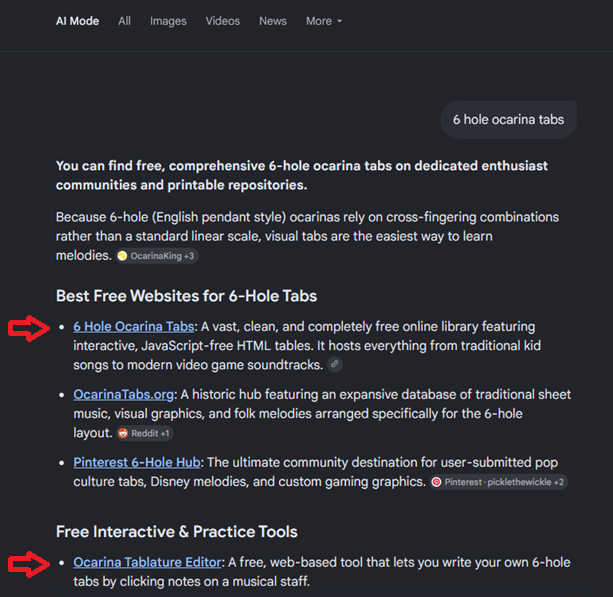
Individual songs are built to win the exact phrase a real person types (a specific, low-competition search like “song of time 6 hole ocarina tab”) rather than fighting a huge generic term nobody wins cheaply. Run one yourself and see where this site lands. Results shift by location and over time, so treat it as a live check, not a fixed claim:
- Song of Time - run the search
- Zelda’s Lullaby - run the search
- Amazing Grace - run the search
- Twinkle Twinkle Little Star - run the search
The move off WordPress lost nothing#
The site used to run on WordPress at those same web addresses. When it was rebuilt, every single song kept its exact old address on purpose. Why it matters: a web address is where both bookmarks and years of built-up search ranking live. Change the address and you throw that ranking away and start over. Keeping every address identical meant the day the new site went live, all that free-traffic value carried straight across with nothing broken. The few pages that genuinely moved get tidy, permanent forwarding so nothing lands on a dead end.
Turning visitors into subscribers and customers#
Traffic on its own is just a number. The point is to do something with it: stay in touch, and give people a way to support or hire you. This is where the site stops being a brochure and starts being a business.
Capturing leads (email sign-ups)#
A visitor who reads one song and leaves is gone forever. A visitor who hands you their email can be reached again the next time there is something worth sharing. The site has a sign-up form that collects exactly that, the single most valuable thing a website can gather. It uses “double opt-in,” meaning the person confirms by clicking a link in an email before they are added, which keeps the list clean and consenting, and every message has a one-click way to leave. Why it matters: an email list is an audience you own outright, not one you rent from a social network that can change the rules overnight. It is the difference between hoping people come back and being able to invite them.
Turning that list into revenue#
Once people are on the list, the site is set up to earn from that attention without being pushy: a tip jar (a “buy me a coffee” style link), a way to request a song, and a hire-me link, all sitting quietly at the foot of the pages. Point them at a service like Ko-fi, PayPal, or Stripe and the buttons light up everywhere at once; leave one blank and it simply disappears, so there are never broken links. The newer piece is an upsell: someone who came for a free tab can be offered something extra of value, processed through Ko-fi. Why it matters: this is the whole funnel in one place, attract with free content, capture the email, then offer something paid, and it runs without a shopping-cart plugin, a store, or a monthly fee for the privilege.
Free word-of-mouth, built in#
Every song carries a row of share buttons (X, Facebook, Reddit, LinkedIn, WhatsApp, Telegram, email, and more) so a reader can pass it to a friend in one tap. Which buttons appear is a single setting, flipped on or off in seconds, no add-on required. Why it matters: every share is a free advertisement that brings a new visitor who might sign up, and it costs you nothing. It is the cheapest traffic there is, and people expect the buttons to be there.
A contact form with no middleman#
The contact form collects messages without renting a third-party form service and without exposing a vulnerable server. A note quietly checks that the sender is a real person (no annoying puzzle), stores the message in a database the owner controls, and emails a notification. If someone has JavaScript switched off, there is still a plain email fallback, so nobody is ever locked out of reaching you. Why it matters: you never lose a potential customer to a broken form or a service outage you do not control.
Fast, because it carries almost nothing#
Speed is not vanity. A slow page loses visitors before they see anything, and search engines openly rank slow pages lower. So speed protects both your traffic and your conversions. This site is fast by design, not by a trick bolted on at the end:
- The finger charts are drawn as SVG (math-based line drawings) instead of photos, so they stay razor sharp at any size and weigh almost nothing.
- The note sounds are created by the browser on the spot, so there are no audio files to download at all.
- No song page carries a single heavy image or media file.
- There is no bulky framework running in the background, only the lean files the site actually needs.
- Before publishing, the site automatically strips every needless space and comment out of its code and bundles many small files into a few, so a visitor’s browser makes fewer, smaller requests.
- Finished pages are delivered from a global network of servers (“a CDN”) that keeps copies close to every visitor, so the page comes from nearby instead of from one far-off machine.
The result is a top score across the board. You do not have to take that on faith: test the live site on Google PageSpeed Insights, Google’s own free speed grader, which re-measures it every time you run it. Why it matters, in one line: faster pages keep more of the visitors you worked to earn, and nudge your ranking up at the same time.
It works for everyone#
Roughly one in five people has a disability that affects how they use the web (limited vision, no use of a mouse, and so on). A site that ignores them turns away that whole share of its audience, and in many places it is also breaking the law. This site is built to a recognized standard, WCAG 2.1 level AA, the same benchmark accessibility lawsuits are measured against. In plain terms:
- Everything you can do with a mouse, you can also do with just the keyboard, with a clear outline showing where you are and no way to get stuck.
- Every playable note is named in text (for example “C5 - A”), so a blind visitor’s screen reader announces the actual note instead of saying nothing useful.
- No meaning is carried by color alone; an active note also changes shape, so it still reads for a color-blind visitor, and people who prefer less motion get no animation.
- Sound is always an extra, never the only signal, and it never blares out on its own.
- Text stays easy to read against its background in both the light and dark themes.
- There is a plain-language accessibility statement with a working way to report any problem.
These are not promises made on trust. An automated test suite checks the song pages, the editor, and the contact form for accessibility every single time the site changes, so an accidental slip is caught before anyone ever sees it. Why it matters: you reach the largest possible audience, you remove a real legal risk, and, as a bonus, most of the same work makes search engines happier too.
Locked down#
A hacked website is not a maybe for most small sites, it is a when, and the cleanup is expensive, embarrassing, and bad for your search ranking. This site removes most of that risk by design.
The reason is structural. A typical WordPress site is a live program running on a rented computer with a database and a login page, all reachable from the public internet, which is a standing invitation for attackers. This site has none of that in front of visitors. What the public reaches is just finished pages, with no login to break into and no database to steal. On top of that, the site sends the full set of modern safety instructions to every browser (the technical name is security headers): it forces a secure, encrypted connection every time, tightly limits what the page is allowed to load, and switches off browser powers it does not use (camera, microphone, location). You can grade it yourself with the free securityheaders.com scanner. Why it matters: no surprise “your site was hacked” email, no ransom, no emergency cleanup bill, and no reputation hit from serving spam to your own visitors.
It runs itself for next to nothing#
The quiet luxury here is how little tending the site needs and how little it costs. This is where the ongoing time and money savings live.
Built from reusable pieces#
Anything that repeats across the site (the contact form, the song count, the related songs, the share buttons, the support links) is written once and reused everywhere. Drop in a short tag and the whole thing appears, wired up and identical to every other page. Why it matters: change it in one place and every page updates at once. There is no stale copy drifting out of sync, and no risk that page 40 quietly differs from page 4. It is the opposite of the WordPress habit of pasting the same widget into dozens of pages by hand.
The indexes rebuild themselves#
The list of every page (the sitemap), the search feature’s behind-the-scenes index, the related-songs lists, the running song count, and the category browsing pages are all regenerated automatically every time the site is published. Why it matters: you add a song and everything that should mention it updates itself. Nothing is maintained by hand, so nothing is ever forgotten or left inconsistent. That is hours of fiddly upkeep that simply never happens.
Everything is backed up and reversible#
The entire site (content, layout, and settings) is stored as plain readable files with a complete history, backed up off-site. Why it matters: any change can be undone, any version recovered, and the site can never be lost to a crashed server or a bad edit. The same history is what lets the automated tests guarantee a future change does not quietly break something that used to work.
Maintained by AI, safely#
Because the whole site is plain text in one place, an AI coding assistant can read every page and setting at once and carry out a request across the entire site consistently (“check every song page for a broken heading,” say), then preview it, run the automated tests, save it to history, and publish, all in one pass. Why it matters: work that used to take a person hours of careful clicking now takes minutes and is safer, because nothing goes live until it has been previewed and tested. That is a real cut in the labor cost of running the site.
What it actually costs#
Rough figures, because prices change, but the shape is the point:
- Hosting: served from a global network on a free tier that comfortably covers a site like this. No monthly server bill. The old WordPress setup ran on a rented server at about $10 a month, paid every month whether one person visited or a thousand.
- Email (contact notices and newsletter): the sending service charges roughly $0.10 per 1,000 emails, so even a busy month is small change. Mainstream email platforms bill by list size and commonly run from tens to hundreds of dollars a month for the same delivery.
So the everyday cost is close to zero, and even scaled up to serious email volume it stays a rounding error next to a typical WordPress host plus a marketing-email subscription. That is the headline again: tens of thousands of visitors, a working lead funnel, for under a dollar a month.
Private by design#
No accounts. No ads. No third-party tracking scripts following anyone from site to site. The only numbers collected are anonymous and totaled up (how many visits, how quickly pages load, that sort of thing), never anything that identifies who you are. The site does not need to know you to hand you a tab. Why it matters: privacy is increasingly what people expect and what the law rewards, and it is simply the decent default.
Any look you want#
A fast, text-first page can read as plain, and that is a deliberate trade: every bit of weight not spent on decoration is a page that loads sooner and stays accessible. But nothing here forces a plain look. The design runs on a mature, highly configurable theme (Blowfish), and its appearance is set in a settings file, not baked into the pages.
Colors, fonts, spacing, the header, the menus, and the homepage style are all settings. This site uses a warm color scheme (burnt orange on slate) defined in one small file; swapping in a different palette, a photo-led homepage, big featured images, or a card grid is a settings change, not a rebuild. And it already looks right everywhere: the layout adapts from a wide desktop down to a narrow phone, switches between light and dark automatically, and the wide tab tables scroll inside their own frame so they never break the page on a small screen. There is no separate mobile site to maintain. Why it matters: the fast, secure, accessible foundation stays put no matter how visual you want the surface to be, so a redesign is cheap and low-risk.
A couple of nice touches#
- A custom “page not found” screen that, instead of dumping a lost visitor at a dead end, points them to search, the song categories, and the homepage, so a wrong link still keeps them on the site.
- A print-friendly layout: hit Print and the menus and buttons fall away, leaving a tidy practice sheet with the title, the tab, and clean black-on-white finger charts that try not to split a note across a page break.
A built-in tablature editor#
Beyond the library, the site includes a browser-based ocarina tablature editor for composing and sharing your own 6-hole ocarina snippets. Click notes, rests, and line breaks, and it hands you a shareable link and the exact table the site’s own pages use. Like everything else, it is plain browser code with no sign-up and nothing to install. Why it matters: it is a genuine tool that gives people a reason to come back and to share, which is more free traffic and more good will.
Who made this#
This site was designed, built, and is maintained by James, the developer behind Digital Crunch. The goal was a small, free resource that also quietly does the engineering right: findable, fast, accessible, secure, private, and durable, on hosting that costs almost nothing to keep running, and wired to actually earn its keep. If you want a site that works like this one, a site that brings in free traffic and turns it into subscribers and customers instead of just sitting there, that is exactly the kind of work Digital Crunch does.
Questions, or a song request? Get in touch.